LED light guide panels are used to create thin, uniform backlighting for signs, retail displays, display cabinets, furniture, luminous ceilings and OEM equipment. A common design question is whether a conventional light guide panel is sufficient or whether the project needs an edge-to-edge illuminated panel with no visible dark border.
This guide explains how the two constructions differ, where the unlit perimeter comes from, and when a custom edge-to-edge LED light guide panel provides a useful visual advantage.
What Is a Conventional LED Light Guide Panel?
A conventional LED light guide panel uses a clear PMMA acrylic light guide plate to carry light from LEDs positioned along one or more edges. A laser-engraved, printed or machined optical pattern redirects the light toward the front surface. Diffuser and reflector layers help produce a smooth illuminated area.
This construction is also described in the market as an LED light sheet, acrylic light guide plate, LGP, edge-lit LED panel or LED backlight panel. The terminology varies, but the basic purpose is the same: distributing light from the panel edge across a thin, flat surface.
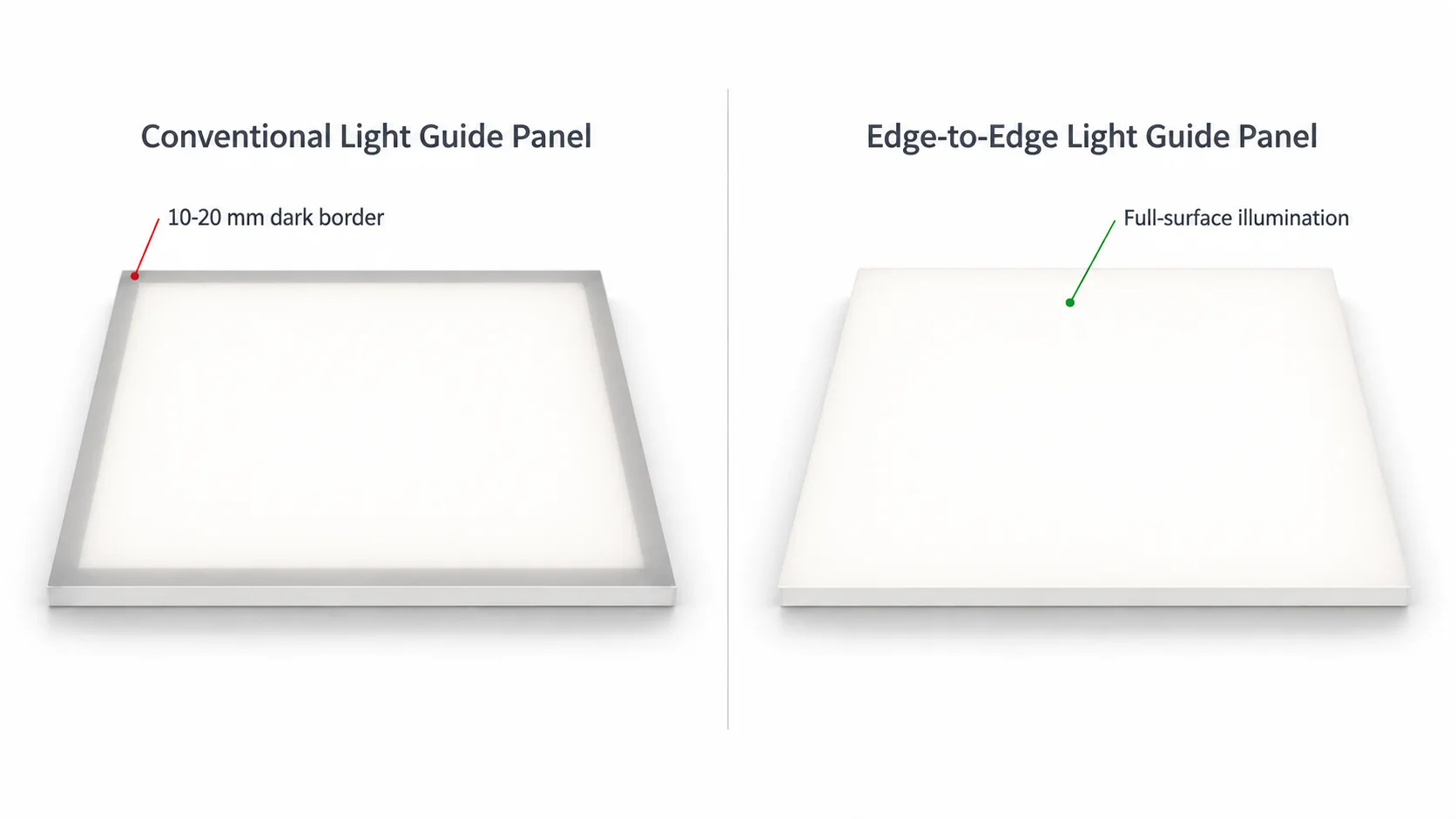
Why Do Traditional Light Guide Panels Have a Dark Border?
On many conventional panels, the LED entry area, internal construction and finishing layers leave approximately 10-20 mm around the perimeter that is not part of the visible luminous surface. This border is usually hidden behind a metal frame, graphic frame, cabinet lip or architectural trim.
That is not necessarily a defect. If the installation already includes an opaque bezel, the border may never be visible. It becomes a design limitation when the panel edge must remain exposed, when the maximum possible luminous area is required, or when several panels need to form a visually continuous illuminated surface.
What Does Edge-to-Edge Illumination Mean?
Edge-to-edge illumination means that the visible luminous surface continues to the panel perimeter instead of stopping at a conventional dark border. It describes the optical appearance of the illuminated face. It does not automatically mean that every installation can omit a protective frame or structural support; mounting and protection should still be designed for the application.
Edge-to-Edge vs Conventional Light Guide Panel
| Comparison | Conventional Light Guide Panel | Edge-to-Edge Light Guide Panel |
|---|---|---|
| Visible perimeter | Typically includes a 10-20 mm non-illuminated border | Luminous surface extends to the visible panel edge |
| Best installation | Border is concealed by a bezel, frame or trim | Panel edge is visible or a clean full-surface effect is required |
| Adjacent panels | Dark perimeter may make panel divisions more noticeable | Supports better visual continuity between illuminated modules |
| Usable luminous area | Smaller than the overall panel footprint | More of the visible panel face is illuminated |
| Custom engineering | Available depending on the supplier and construction | Designed around project dimensions, shape, light color and control requirements |
| Cost and complexity | Often practical for standard framed applications | Most valuable where the edge-to-edge effect solves a visible design requirement |
Advantages of an Edge-to-Edge LED Light Guide Panel
1. Cleaner Visible Edges
When the panel is intentionally exposed, removing the conventional dark perimeter creates a cleaner and more finished appearance. This is useful for minimalist fixtures, illuminated furniture, product displays and architectural details.
2. More Usable Illuminated Surface
For a fixed external size, a larger proportion of the front face can contribute to the visible lighting effect. That can be important in narrow panels, compact displays and designs with limited installation space.
3. Better Continuity Across Multiple Panels
In luminous ceilings, illuminated walls and modular displays, repeated dark borders can interrupt the overall effect. Edge-to-edge panels can reduce that visual interruption, although the physical joint and mounting system must still be considered in the final design.
4. Made for Non-Standard Projects
Custom light guide panels can be developed from project drawings in round, square, rectangular and long linear formats. Cable position, cut-outs, voltage, light color and control method can be reviewed before production.
When Is a Conventional Light Guide Panel Still the Right Choice?
A conventional panel remains a practical solution when the non-illuminated edge is completely concealed, standard sizes already fit the installation, or the project does not require a continuous visible luminous surface. The edge-to-edge option should solve a real design requirement rather than being specified only because it sounds more advanced.
Typical Applications
- Backlit signs, logos and menu boards
- Retail display shelves and product showcases
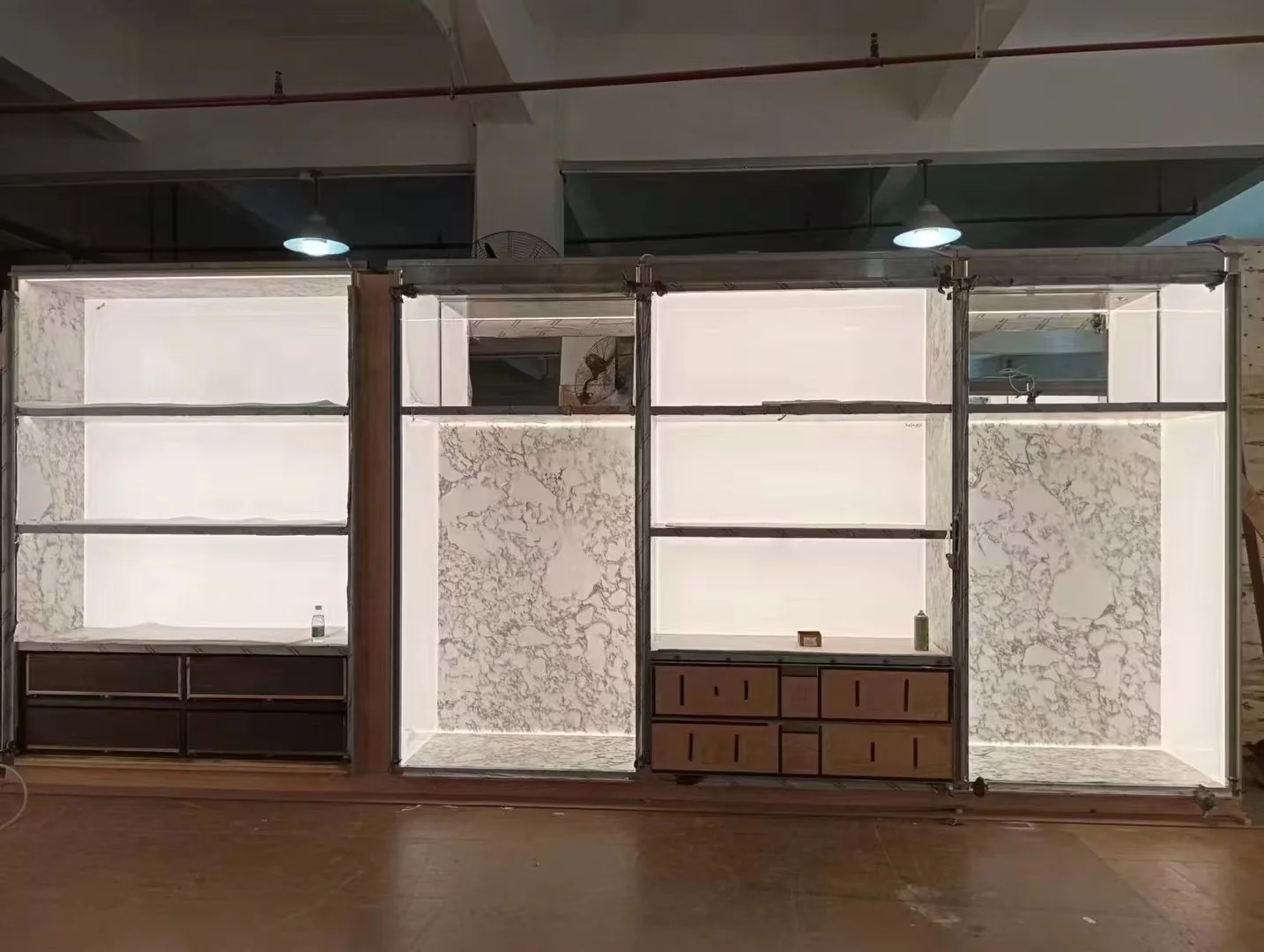
- Display cabinets and illuminated furniture
- Luminous ceilings, walls and architectural features
- Exhibition and museum display systems
- Custom lighting integrated into OEM equipment
- RGBW or tunable-white decorative installations
What Information Is Needed for a Custom Panel?
- Overall dimensions, shape and drawing
- Required quantity and installation method
- 12V DC or 24V DC input
- Fixed color temperature, tunable white, RGB or RGBW
- On/off, dimming or DMX512 control
- Cable outlet position and connection requirements
- Visible surface, mounting clearance and environmental conditions
YIZEE Custom Edge-to-Edge Panel Options
YIZEE produces made-to-order PMMA acrylic LED light guide panels in 15 mm and 25 mm versions. Available configurations include 12V or 24V input, custom color temperature, tunable white, RGB, RGBW, dimming and DMX512 control. Power can be designed up to 80 W/m² according to the project, with no fixed minimum order quantity and an approximate 15-day production period after the design is confirmed.
Planning a custom backlighting project? View the edge-to-edge LED light guide panel specifications and project images, then send the dimensions, drawing and lighting requirements for review.
Frequently Asked Questions
Is an LED light sheet the same as a light guide panel?
The terms are often used for similar thin backlighting products. Construction details vary by manufacturer, so buyers should confirm the panel material, thickness, LED arrangement, diffuser, voltage and control method rather than relying only on the product name.
Does edge-to-edge illumination mean the panel needs no frame?
No. Edge-to-edge describes the visible luminous surface. A frame, channel or other support may still be required for mounting, protection and project integration.
Can edge-to-edge panels use RGBW or DMX512?
Yes. YIZEE can develop fixed-white, tunable-white, RGB and RGBW configurations with dimming or DMX512 control, subject to the confirmed panel design.