Slug: dotless-led-strip-lights-complete-guide
Meta description: Tired of visible LED dots? Learn how COB LED strips eliminate hotspots, when dotless matters, and how to choose density, CRI, and voltage for a seamless line of light.
目标关键词: dotless led strip, dotless led strip lights, no dot led strip, seamless led strip, COB led strip
Standard LED strips have a familiar flaw: step close to an "indirect" cove and you see a row of bright dots instead of a smooth band of light. Designers call them "disco dots," and they’re the single most common complaint in residential and hospitality lighting.
Dotless LED strip lights solve this at the source. This guide covers how the technology works, where it earns its premium, and the specifications that determine whether your installation actually looks dot-free.
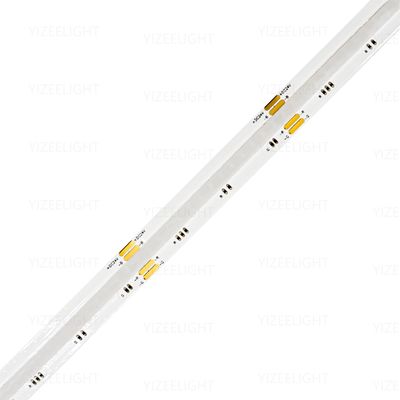
Why LED Strips Show Dots in the First Place
A conventional SMD strip mounts discrete LED packages (diodes) on a PCB with visible spacing — commonly 60, 120, or 240 LEDs per meter. Inside an aluminium profile with a diffuser, the light from each diode forms a bright spot that fades before reaching the next one. Whether you see dots depends on:
- LED density (diodes per meter)
- Distance from strip to diffuser — the farther, the more the beams blend
- Diffuser quality — opal diffusers hide more than clear ones
- Viewing angle — grazing views along the profile reveal dots that frontal views hide
You can fight dots with density and deep profiles, or you can eliminate them structurally with COB technology.
How COB Strips Achieve a Truly Dotless Line of Light
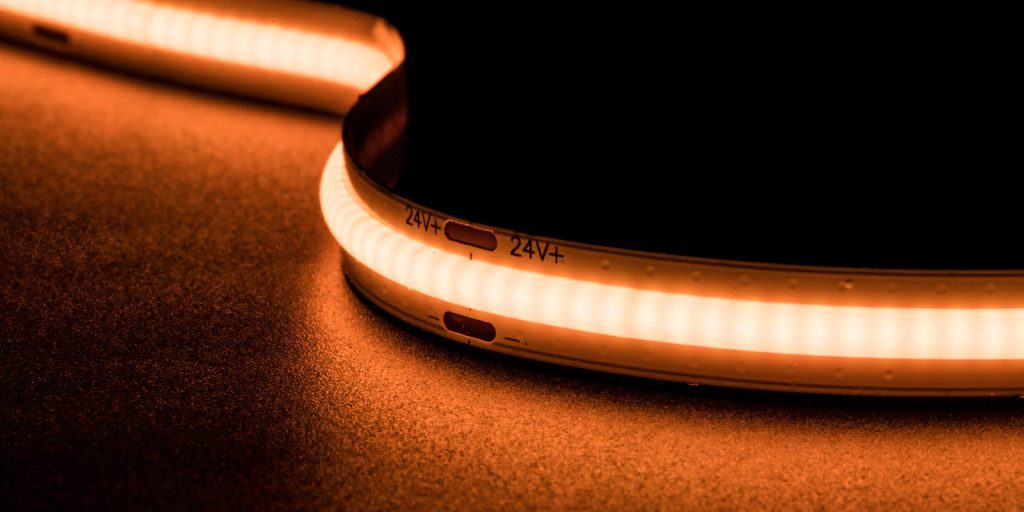
COB (Chip On Board) flips the construction: instead of individual diodes with gaps, hundreds of bare LED chips are mounted directly across the full width of the strip and sealed under a continuous phosphor layer. The emitting surface becomes a uniform ribbon with effectively zero visible points.
The practical differences:
| | SMD strip | COB strip |
|—|—|—|
| Hotspots | Visible at close range / shallow channels | None, even at shallow depths |
| Bend flexibility | Good | Excellent (thin, no bulky diodes) |
| Light-emitting angle | ~120° | ~180° |
| Cut increment | Wider | Often 2.5–5 cm |
| Cost | Lower | Moderately higher |
The wider 180° emission is the sleeper benefit: COB strips wash walls and diffusers more evenly, so shallow profiles that would show striping with SMD work fine with COB.
When Dotless Matters Most
Shallow profiles and tight coves. If your extrusion is under ~15 mm deep or the diffuser sits close to the strip, COB is the reliable answer — don’t gamble on high-density SMD.
Reflective surfaces. Polished stone, glossy lacquer, and mirrors mirror every diode. Dotless strips disappear into these finishes.
Hospitality and retail. Bars, boutiques, and hotel corridors get viewed at close range and odd angles — exactly the conditions that expose dots.
Curved and irregular runs. COB’s thin, uniform construction follows tight curves without the "beaded" look of discrete diodes around a radius.
Where dots don’t matter: hidden uplighting onto matte ceilings with deep coves, rough outdoor surfaces, and anywhere the strip is more than ~50 mm from its visible surface with an opal diffuser.
Specifications That Determine the Result
1. Chips per meter. COB strips commonly run 320, 384, 480, or 528+ chips/m. Higher counts give a denser, more forgiving ribbon — 480 chips/m is the sweet spot for most architectural work.
2. CRI. For spaces where color matters (retail displays, galleries, skin tones), specify CRI ≥ 90. The difference between CRI 80 and 90 is visible, and the price gap has narrowed dramatically.
3. Color consistency. Ask for binning within 3 SDCM — step macadams of 3 or less read as uniform across a run and between runs. This is where cheap COB strips fail: one reel slightly greener than the next.
4. Wattage and heat. Dense COB strips run warm — a 480 chips/m strip at 10–14 W/m needs a real aluminium profile as a heatsink, not a plastic channel. Derate in enclosed spaces.
5. Voltage. 24 V is the modern default: longer runs than 12 V, safer than mains. For very long runs (hotel corridors, façade coves), 48 V versions cut voltage-drop headaches.
6. Width and cut length. 8 mm and 10 mm widths fit standard mini profiles; cut lengths of 2.5–5 cm waste less material at the end of runs.
COB vs. High-Density SMD: A Honest Comparison
High-density SMD (240+ diodes/m) with a quality opal diffuser in a deep profile can look dotless — at front view. COB looks dotless from every angle, in shallower profiles, with thinner diffusers. If the budget is tight and the profile is deep, dense SMD remains valid. If the design is shallow, curved, reflective, or close-range, COB is the safer specification — and the small price premium is cheaper than one callback.
Installation Notes
- Profile depth still matters. COB is forgiving, not magic: below ~8 mm diffuser depth, expect faint banding on very high-output strips.
- Don’t overdrive. Run strips at 80–90% of rated power — you lose almost no perceived brightness and gain lifespan and color stability.
- Power injection on long runs. Beyond ~8–10 m at 24 V, feed from both ends or mid-run to avoid the last meters reading dimmer.
- Handle the phosphor layer carefully. COB strips scratch more easily than SMD diodes — avoid dragging across unsealed metal edges during installation.
Where COB Fits YIZEE’s Range
YIZEE’s COB lineup covers the full dotless specification space: single-color white in 2700 K–6500 K, CCT tunable 2700 K–6000 K, RGB and RGB+CCT in one strip, from 8 mm slim formats up to high-output 12 mm — all with CRI 90+ options and 3 SDCM batch matching as standard.
→ Explore CCT tunable white COB strips, the COB strip range, or request samples for your mock-up.
Frequently Asked Questions
Are COB strips dimmable?
Yes — with any dimmable 24 V driver (DALI, 0–10 V, TRIAC). Their uniform emission actually dims more gracefully than SMD, which can show "stepping" at low levels.
Can COB strips be cut?
Yes, at marked cut lines — typically every 2.5 cm, 5 cm, or 10 cm depending on chip density and circuit design.
Do dotless strips last as long as SMD?
Comparable — 30,000–50,000 hours is typical for quality products. The continuous phosphor layer actually protects chips from mechanical damage better than exposed SMD diodes.
Can I get dotless in tunable white or RGB?
Yes. CCT tunable COB (warm-to-cool in one strip) and RGB/RGBW COB are mature products. RGB+CCT combines both in a single dotless ribbon.
Will a diffuser still be needed with COB?
For most installations, yes — the strip is bright to look at directly and a diffuser (even a shallow clear one) softens glare and improves uniformity. COB’s advantage is it works with much shallower diffusers than SMD.
Specifying a cove, joinery, or hospitality project where dotting would be visible? Send us the profile depth and run lengths — we’ll recommend the exact strip, and ship mock-up samples so you can verify the effect before ordering. Request a factory quote.