Slug: 360-degree-neon-flex-complete-guide
Meta description: What is 360° neon flex? Learn how round silicone neon tubes work, where to use them, and how to choose diameter, IP rating, and voltage for your project.
目标关键词: 360 neon flex, 360 degree neon flex, round neon flex, 360 neon light
Traditional neon flex emits light from one side only. That works for coves and flat signage — until your design wraps around a column, threads through a railing, or hangs freely in space. That is exactly the gap 360-degree neon flex was built to fill.
In this guide, we cover what 360° neon flex is, how it differs from directional neon, where it performs best, and the specifications that matter when sourcing it from a manufacturer.
What Is 360-Degree Neon Flex?
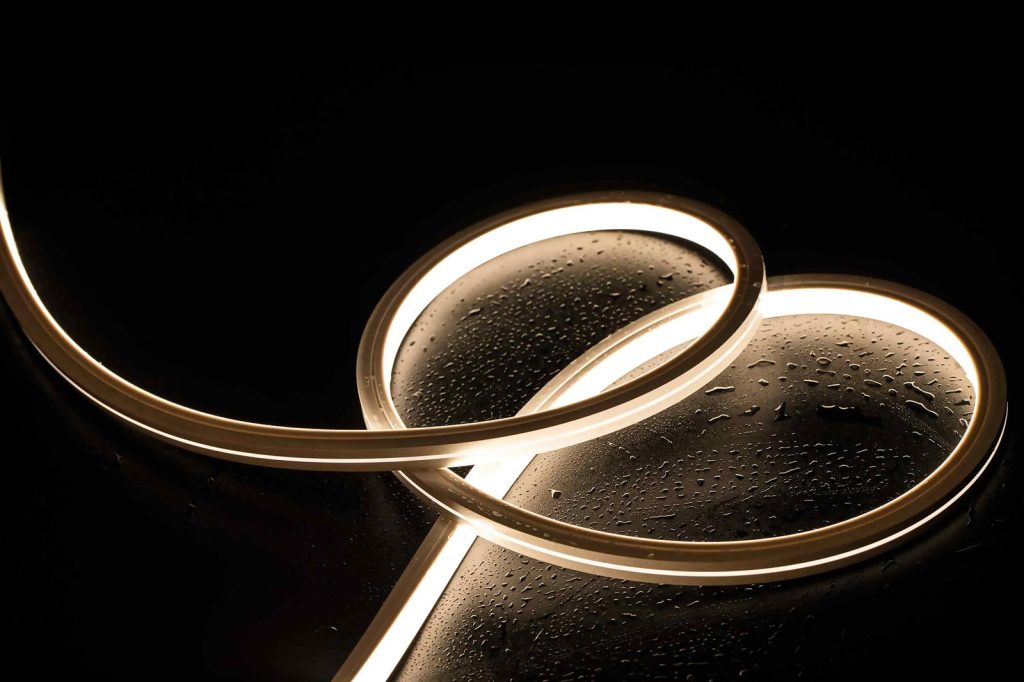
360-degree neon flex (also called round neon flex or 360° silicone neon tube) is a flexible LED lighting product with a cylindrical, fully luminous silicone body. Instead of an LED strip mounted against a flat wall inside a half-round diffuser, the LED source is centered inside a round extrusion, so light radiates uniformly in every direction.
Typical constructions include:
- LED engine: SMD LED strip or COB strip at the core
- Diffuser body: extruded silicone (UV-resistant, flame-retardant, typically IP67 or IP68)
- Cross-sections: commonly Ø18 mm and Ø25 mm diameters
- Voltages: 24 V DC for most architectural runs; 110/220 V AC for long, simple installations
360° Neon vs. Directional Neon Flex
| Feature | 360° round neon | Flat / directional neon |
|—|—|—|
| Light emission | All directions | One direction |
| Mounting | Suspended, surface, or sleeved | Surface only (needs a base) |
| Columns & railings | Excellent | Poor |
| Cove / backlight | Good, some waste upward | Excellent |
| Visible from both sides | Yes | No |
The rule of thumb: if the tube itself is visible as a design element — and people will see it from multiple angles — choose 360°. If the tube is hidden in a channel washing a surface, directional neon is more efficient.
Where 360° Neon Flex Performs Best
Building outlines and rooflines. A continuous round tube of light traces parapets, canopies, and architectural edges with no dark side, even on corners viewed from below.
Columns and trees. Spiral-wrapped or vertically sleeved columns glow from every approach angle — a signature look in retail, hospitality, and landscape lighting.
Suspended "light lines." Hung with cables at bar counters, event spaces, and atriums, 360° tubes replace costly custom pendants. One power feed lights the whole drop.
Bridges, railings, and handrails. Round silicone tubes thread through guardrails and along walkway edges with full radial visibility for pedestrians on both sides.
Signage and art installations. Neon-style lettering and freeform shapes where the stroke itself is the artwork.
Specifications That Actually Matter
1. Diameter. Ø18 mm suits delicate details and tight spirals; Ø25 mm reads as a bold "neon" stroke at architectural scale. Smaller diameters bend tighter.
2. Bending radius. Ask for the minimum bending radius before you design. A quality Ø18 mm round tube typically bends to around 80–100 mm; Ø25 mm needs more. For sharper curves, specify a product validated for tight bends — cheap tubes kink and develop dark spots.
3. IP rating. For outdoor use, IP67 is the practical minimum (rain, jets); IP68 suits submerged or permanently wet locations. Indoors, IP65 is usually enough.
4. Lumen output per meter. Round tubes diffuse light through more material than flat neon, so check lm/m, not just W/m. For Ø25 mm tubes, look for roughly 600–900 lm/m depending on LED density.
5. Cut length and max run. Standard cut increments are commonly 5 cm or 10 cm. Check the maximum continuous run at your voltage — 24 V runs are shorter than 220 V runs. For Ø25 mm 360° tubes running tens of meters, high-voltage versions with simple power feeds are worth considering.
6. Silicone quality. Platinum-cured silicone resists yellowing and cracking far better than cheap PVC alternatives, especially outdoors. Specify UV-stabilized, flame-retardant silicone for any exterior project.
Installation Notes
- Suspension: use transparent or color-matched suspension kits every 1–1.5 m; sagging reads as a defect on long runs.
- Power injection: on runs over ~10 m (24 V), inject power from both ends or mid-run to prevent visible dimming.
- Heat: silicone handles heat well, but closed channels still need airflow — never pack a tube tightly into an unventilated metal sleeve.
- Color consistency: buy all tubes for one façade in a single production batch; request a binning (SDCM ≤ 3) guarantee for large orders.
Sourcing 360° Neon Flex from a Manufacturer
Most buyers importing 360° neon flex run into the same problems: inconsistent brightness between batches, connectors that leak, and tubes that yellow within a year. When evaluating a factory, ask for:
- IES or integrating-sphere test reports for lm/m and CCT
- IP test reports from a third-party lab (not self-declared)
- UV aging test data for outdoor projects
- Samples from the actual production line you’ll be ordering from
YIZEE manufactures 360° round silicone neon flex in Ø18 mm and Ø25 mm, in 24 V and high-voltage versions, with IP67 ratings as standard. Every roll is batch-tested for lumen consistency before packing.
→ Explore our 360° round neon flex range or request a sample for your project.
Frequently Asked Questions
Can 360° neon flex be cut?
Yes — at marked cut lines, typically every 5–10 cm depending on the model. Always seal the end cap and any cut joint with the manufacturer’s glue kit to maintain the IP rating.
Is 360° neon dimmable?
With the right driver/controller, yes. Use dimmable 24 V drivers (DALI, 0–10 V, or TRIAC) for DC versions, or dimmable AC controllers for high-voltage runs.
How long does outdoor 360° neon last?
Quality silicone tubes with a 24 V LED core are typically rated 30,000–50,000 hours. The silicone skin usually outlasts the LEDs — look for replaceable-core designs if serviceability matters.
What’s the difference between 360° neon and "LED rope light"?
Rope light is a string of discrete LEDs inside a PVC tube — you see hotspots. True 360° neon flex uses a dense LED core with a thick silicone diffuser, giving a continuous, dot-free glow.
Can I get 360° neon in RGB or tunable white?
Yes. RGB, RGBW, and CCT tunable versions are available in round formats, though diameters and minimum bend radii differ from single-color versions.
Need a specific diameter, color, or IP rating for your project? Request a factory quote — we reply within 24 hours with specs, pricing, and sample options.