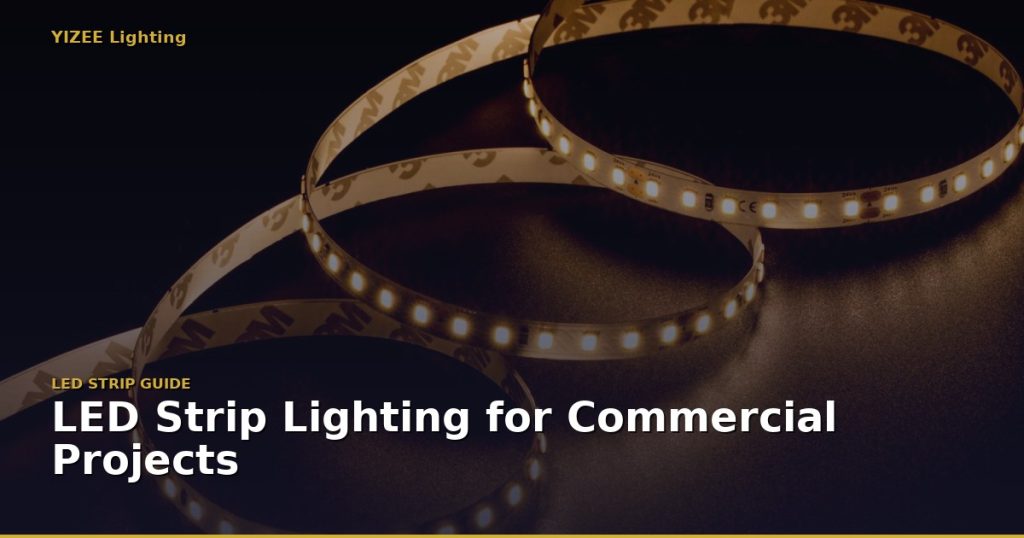
LED Strip Lighting for Commercial Projects: A Specifier’s Guide to Sourcing from China
If you’re a lighting specifier, architect, or project contractor working on commercial installations, sourcing LED strips directly from Chinese manufacturers can cut your costs by 40-60% compared to domestic suppliers. But quality control and communication challenges can turn savings into expensive headaches.
This guide covers everything you need to know to source with confidence.
Why Source LED Strips from China?
China produces over 80% of the world’s LED strips. The advantages of direct sourcing include:
- 40-60% cost savings compared to buying from domestic distributors
- Full customization — custom PCB width, LED density, color temperature, length, and connectors
- OEM/ODM capability — private label packaging with your brand
- Large capacity — manufacturers can handle orders from 100m to 100,000m
How to Evaluate a Chinese LED Strip Manufacturer
Not all manufacturers are equal. Here are the key factors to assess:
1. Factory vs Trading Company
Always prefer actual manufacturers over trading companies. Trading companies add markup without adding value. How to tell the difference:
- Request factory photos and video tours
- Ask about production capacity and lead times
- Check if they can customize specifications (traders usually can’t)
- Look for ISO 9001 factory certification
2. Quality Certifications
For commercial projects, verify these certifications:
- CE + RoHS — Minimum for European and most international markets
- UL / ETL — Required for North American commercial installations
- FCC — Required for US market
- SAA — Required for Australian market
Request actual certificate copies, not just claims.
3. LED Chip Quality
The LED chips determine 80% of the strip’s performance. Top-tier manufacturers use chips from brands like Cree, Lumileds, Seoul Semiconductor, or high-grade Chinese brands.
Ask for:
- LM-80 test reports (LED lifespan data)
- Actual CRI measurements (not just “CRI>90” claims)
- MacAdam ellipse specification (color consistency between batches)
4. Sample Testing
Never skip sampling. A proper evaluation should include:
- Visual inspection — dot uniformity, PCB quality, solder joints
- Brightness test — use a lux meter at standardized distance
- Color temperature verification — use a spectrometer if possible
- 72-hour burn-in test — check for brightness decay and color shift
- Flexibility test — bend the strip to minimum radius multiple times
The Ordering Process: What to Expect
- Inquiry (Day 1) — Send specifications, quantities, and project requirements
- Quotation (Day 1-2) — Receive pricing based on specs and quantity
- Sample (Day 3-8) — Order and test samples before bulk
- Production (Day 7-15) — Bulk production after sample approval
- Quality inspection — 100% aging test before shipment
- Shipping (Day 3-7) — DHL/FedEx for air, 25-35 days for sea freight
Common Pitfalls to Avoid
- Choosing on price alone — The cheapest quote often means inferior chips and shorter lifespan
- Skipping samples — Production quality can differ significantly from catalog specs
- Ignoring MOQ flexibility — Good manufacturers offer reasonable MOQs for first orders
- Not specifying packaging — Commercial projects may need specific labeling and packaging
About YIZEE Lighting
YIZEE Lighting is a Shenzhen-based LED strip manufacturer with 10+ years of experience exporting to commercial projects in 50+ countries. We offer:
- Full product line: COB, SMD, Neon, RGB, Addressable strips + Aluminum profiles
- CE, RoHS, FCC certified; UL available on select products
- CRI 90+ and CRI 95+ options
- MOQ from 100 meters, sample orders welcome
- OEM/ODM with private label packaging
- 3-5 year warranty
Request a quote or view our complete product catalog. We respond to all inquiries within 24 hours.