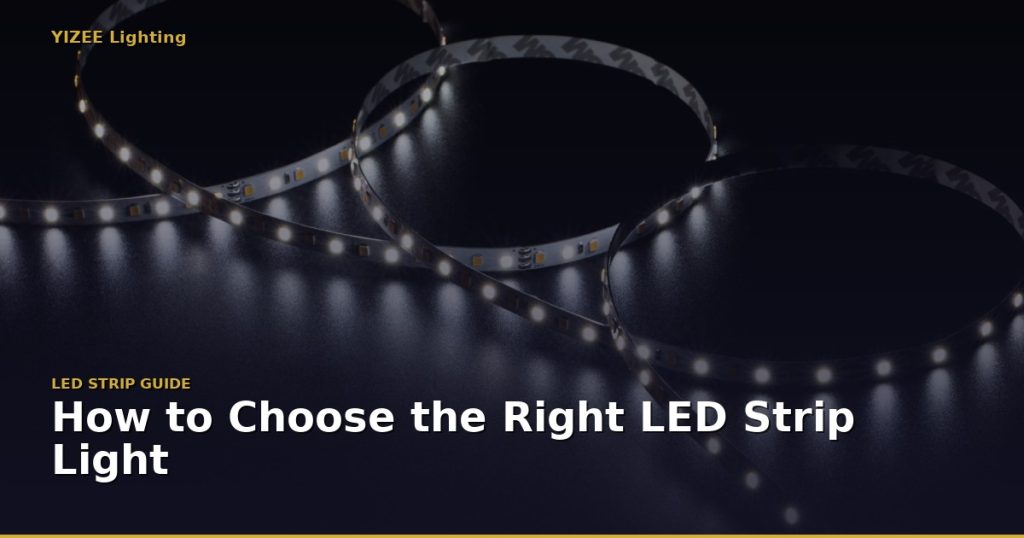
Choosing the right LED strip light can feel overwhelming — with hundreds of options on the market, how do you know which one is best for your project? This complete guide walks you through everything you need to know, from voltage and color temperature to IP rating and CRI.
1. Understand the Different Types of LED Strips
Before diving into specs, it helps to know the main categories of LED strip lights available today:
- SMD LED Strips — The most common type. SMD2835 and SMD5050 are widely used for general lighting and color-changing applications.
- COB LED Strips — Chip-on-Board technology delivers a seamless, dot-free line of light with extremely high lumen output. Ideal for architectural lighting.
- RGB LED Strips — Color-changing strips using Red, Green, and Blue LEDs. Great for decorative and accent lighting.
- CCT Tunable Strips — Dual-white strips that allow you to adjust color temperature from warm white (2700K) to cool white (6500K).
- RGBW/RGBCCT Strips — Combine color-changing with white light for maximum flexibility.
- Silicone Neon Flex — Flexible LED strips encased in silicone, mimicking the look of traditional neon signs with a smooth light effect.
2. Choose the Right Voltage: 12V vs 24V vs 48V
Voltage is one of the most critical choices when selecting an LED strip light. Here’s a quick breakdown:
| Voltage | Max Run Length (no voltage drop) | Best For |
|---|---|---|
| 12V | ~3–5 meters | Small accent lighting, cabinets, displays |
| 24V | ~5–10 meters | Most commercial and residential projects |
| 48V | ~15–20 meters | Long runs, architectural lighting, large-scale installations |
Pro Tip: For most commercial projects, 24V LED strips offer the best balance of run length, brightness, and component availability. YIZEE Lighting supplies high-efficiency 24V LED strips with up to 160LM/W luminous efficacy.
3. Check the LED Density (LEDs per Meter)
LED density — measured in LEDs per meter — directly affects the smoothness and brightness of the light output:
- 60 LEDs/m — Standard density. Visible dots, suitable for behind-furniture or indirect lighting.
- 120 LEDs/m — High density. Much smoother output, great for display cases and retail lighting.
- 240+ LEDs/m — Ultra-high density. Near-dotless effect, ideal for close-view applications.
- COB (300–500+ chips/m) — Completely dot-free. Best choice for linear lighting profiles and premium architectural applications.
4. Select the Right Color Temperature (CCT)
Color temperature is measured in Kelvin (K) and determines whether the light feels warm or cool:
- 2700K–3000K (Warm White) — Cozy, relaxing atmosphere. Best for bedrooms, restaurants, and hospitality.
- 3500K–4000K (Natural White) — Balanced, neutral light. Ideal for offices, kitchens, and retail spaces.
- 5000K–6500K (Cool White / Daylight) — Crisp, energizing light. Best for workshops, showrooms, and task lighting.
If you need flexibility, consider a CCT tunable LED strip that allows dimming and color temperature adjustment via a controller or smart system.
5. Consider CRI (Color Rendering Index)
CRI measures how accurately a light source renders colors compared to natural sunlight (CRI 100). This matters most in retail, museum, and photography applications:
- CRI 80+ — Standard quality, suitable for most general lighting.
- CRI 90+ — High quality. Colors look vibrant and true. Recommended for retail and hospitality.
- CRI 95+ — Exceptional quality. Required for art galleries, jewelry stores, and medical environments.
YIZEE Lighting’s high-efficiency LED strips deliver CRI >90 with luminous efficacy up to 207LM/W, making them a top choice for demanding commercial applications.
6. Understand IP Ratings for Waterproofing
The IP (Ingress Protection) rating tells you how well the LED strip is protected against dust and moisture:
- IP20 — No protection. Indoor use only, dry locations.
- IP44 — Splash-proof. Bathrooms, kitchens (away from direct water).
- IP65 — Dust-tight and water jet resistant. Outdoor covered areas, under-eave lighting.
- IP67/IP68 — Fully waterproof. Submersible applications, pool surrounds.
7. Calculate Your Power Supply Requirements
Always size your LED driver with 20–25% headroom above your strip’s power consumption. For example:
- If your LED strip uses 10W/m over 5 meters = 50W total
- Choose a power supply rated for at least 60–65W
- Use a quality LED driver from a reliable manufacturer to ensure longevity and safety
YIZEE Lighting also supplies a full range of LED drivers and power supplies — from 35W to 400W — with soft-start technology and IP20/IP65 protection to match every installation need.
8. OEM/ODM: Custom LED Strip Solutions
For brand owners, lighting companies, and project buyers, YIZEE Lighting offers full OEM/ODM services:
- Custom LED density, wattage, and PCB width
- Private label and custom packaging
- Custom CCT range and CRI requirements
- Low MOQ for sample orders
- Factory direct pricing with no middlemen
Final Checklist Before You Buy
- ✅ Chosen the right type (SMD / COB / RGB / CCT / Neon Flex)
- ✅ Selected the correct voltage (12V / 24V / 48V)
- ✅ Checked LED density for smooth output
- ✅ Confirmed color temperature matches the space
- ✅ Verified CRI meets your quality requirements
- ✅ Matched IP rating to the installation environment
- ✅ Sized the power supply with 20% headroom
Ready to source professional-grade LED strip lights? Contact YIZEE Lighting for a free product consultation and factory-direct quote. With 10+ years of manufacturing experience, we supply LED strips to customers in over 50 countries.